Showing posts with label East Asian Culture. Show all posts

Thursday, February 9, 2017

Yelling at (Doctor) Strange(rs): An long unbridled reaction to Marvel’s Doctor Strange

The complaints about Doctor Strange are probably much more eloquently put somewhere else but after waiting so long to watch a Marvel movie, which admittedly I really wanted to see, all of my critiques come back to one thing: Tilda Swinton as the Ancient One. Overall, the movie had a strangely large amount of white women in the background, set things in Asia with only one speaking part for a person of Asian descent, and overall attempted to avoid orientalism and instead fell into a mire of first-world problems, colonialism, and whitewashing.

Having all the main plot moving characters (you could have cut Mordo and Wong no problem) be white (Doctor Strange, The Ancient One, and Mads Mikkelson’s character whose name honestly does not matter) came off as super “white people problems”-y. OH NO BUT I WANT TO LIVE FOREVER, why? BECAUSE THE WHITE LADY DID……mk. Therefore the who situation comes off as super paternalistic for the many sorcery students who are not involved with this. One white man wants to save them this way, a white lady wants to save them this way, and in the end the white man saves them. Mads had minimal motivation, the Ancient One came off as super paternalistic (I’M OLD I MADE A LOT OF TOUGH DECISIONS FOR ALL THE LITTLE PEOPLE), and Doctor Strange was honestly fine. He comes across as that guy in high school who you always want to punch in the face, but he has a great dog-cape and most of his annoyance could be overlooked if it wasn’t for the Bald-For-No-Reason-We-Say-We-Are-Celtic-Without-Using-Celtic-Imagery Ancient One.

The plot is the typical Doctor Strange origin story, which can be found in any number of various comics reboots, many are good, and Benedict is the best white-male fit for the character that exists. Enough Sherlock without it being Sherlock and with a sense of humor. Downside is the fact that Marvel could do with a couple fewer Arrogant-Smart-White-Dudes-Who-Love-Showing-They-Know-More-Than-Others, he’s sort of rogue-ish, you sort of like him, but you sort of also just want to punch his smug-ass face over and over until he shuts up. Lots of white-people problems happen (expensive car crash, followed by smug comments about expensive surgery, there are only white doctors, followed by entitled yelling), then he goes to Kathmandu which of course he can still afford to do. Though honestly, it could have been Chinatown in Kansas considering how much it as a setting and the people from there mattered.

This is the crux of many critiques of the character. It was first conceived of in the 1960s when generic “Eastern” mysticism was all the rage. They wanted to incorporate that into the Marvel Universe, so they create a mystical superhero. I get it, it was a product of its time. Now? Not so much. But at least then they claimed ignorance though they actually used some semblance of internal pseudo-Asian logic to move things along. That aside from that we get to Kathmandu, Strange acts like he has no idea how to Google places before he has to travel and wanders around like a stereotypical tourist asking random people where they mystical temple is. No Asian People Are Heard Speaking To Him Until Wong Shows Up Half Way Through The Training Montage.

Seriously, Marvel, what in the actual fuck. We meet the Ancient One, there is a non-speaking older Asian man in the room who then leaves. We get no explanation as to why she is bald (there are no hair length/style requirements at her temple), we are told outright by Baron Mordo that she is Celtic (HEY GUYS SHE’S CELTIC ITS FINE) which is just awful storytelling, and a good portion of the background “help” are white women even in Kathmandu (why?). Also the evil women with Mads are also white but with heavy make-up to show they are bad! We have some training scenes with Paternalistic white woman showing the Asian people how to do body movements that are derived from martial arts started in their own cultures, none of them speak and most of them are light-skinned Asians so no locals from Kathmandu train there. Though, for a good five minutes they are better than the white dude who just arrived. But you know after about a month he’s surpassed everyone who has lived and trained there for years because he’s just that kind of guy. Also you see him read more than you see him practice movement and for the amount of mind-body-united talk there is not much demonstration of that.

We’re introduced to Wong. When the director said they were going to make Wong a “master” this was like 99% talk, we never see him fight or show mastery of anything really. He’s either being outsmarted by the white-guy who’s already better at the thing Wong has trained for his whole life/his librarian job or dead. He is a one-dimensional sidekick but they call him a master and he likes Beyonce so it’s fine guys. He leads a group of students, many in this shot are Asian-descent, into an epic battle where apparently they are all useless and just die because we see none of their skills or anything more of them than a group shot. So is Tilda even that good of a teacher guys? I think not.
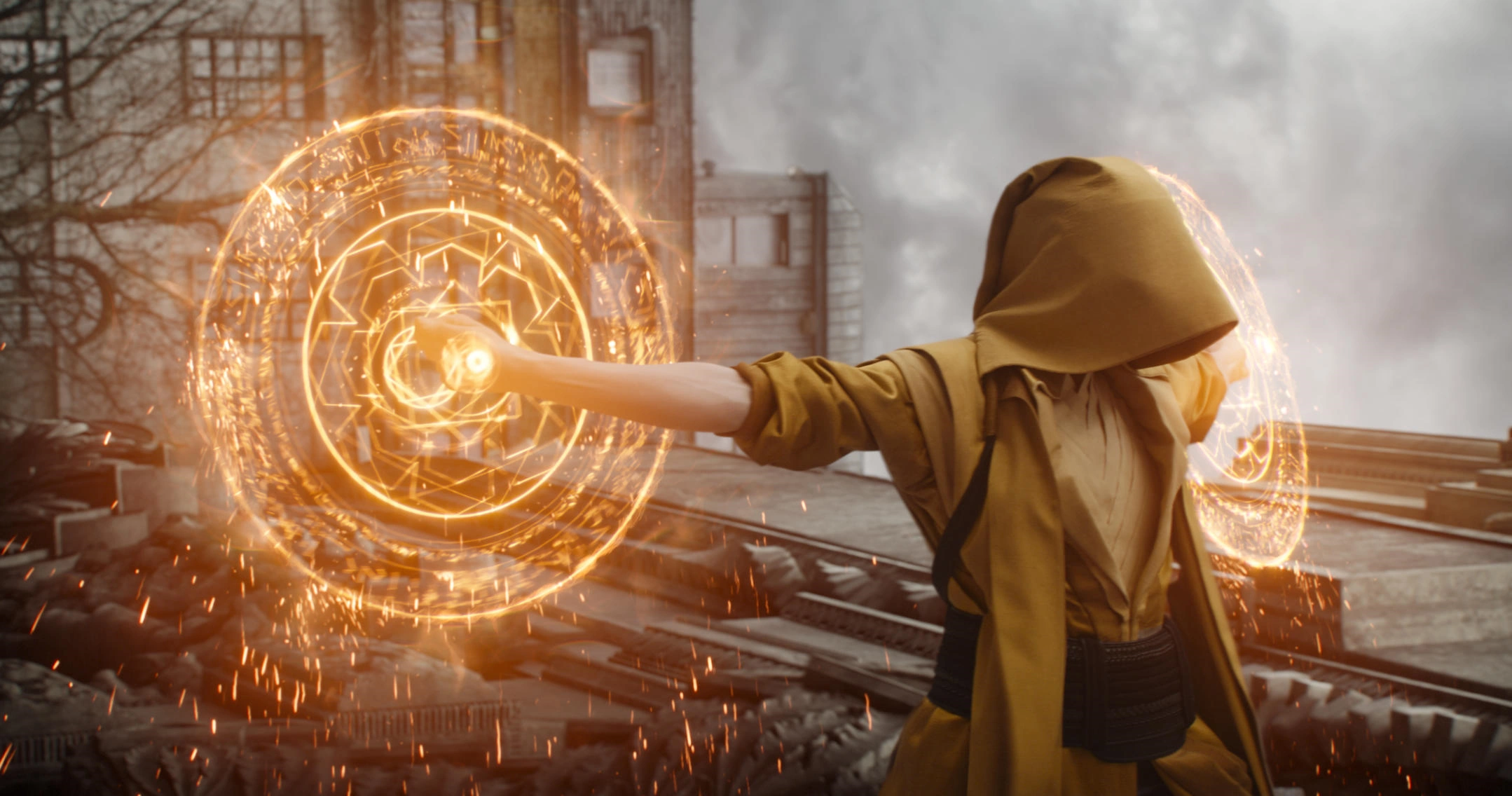
Mk. Where are we…Ah Yes Tilda as metaphor. So, they tried to avoid 1960s orientalism and came off as colonialist. Basic rule of drama: you put a gun on the wall, it’s fired by the last act. You set a story in Asia and it kind of has to matter. Instead, at one, point you LITERALLY FREEZE ALL THE ASIAN PEOPLE AND THEY ARE LITERAL SET PIECES. Antarctica would have also been an OK place for this movie. Also would have looked cool, mirrored glaciers, penguins, the whole shebang. Plus their design team, for the costumes primarily and some of the sets, did lots of looking cool and very little thinking about where styles come from. Have you ever played a JRPG and they use European Armor and you’re like, no guys, that’s not how that armor works. That’s what the design in this came off as. Shape, form, and zero substance. Each martial art has it’s own uniform for a specific purpose that comes from somewhere. At Ms. Tilda’s school for the mystical arts, nah brah, that don’t mean a thing. If even in the design they didn’t draw more than aesthetics for their Asian influences (or heaven forbid hire an Asian designer to think about this shit) why even keep the setting in Asia. Marvel if you are so worried about the Chinese market, higher some Chinese actors and designers to design your shit and at least have it make sense. They basically cafeteria’d it up with generic mystical Asian symbolism and styles and didn’t even do a great job at that. Mine the continent for its mystical substance then distill it into emptiness.

OH best part. The Ancient One telling Doctor Strange the secret is that that he’s not important, demonstrating that he can’t be that smart if he didn’t figure out that blatantly obvious point that most meditation arts cover on day one

THEN

PROCEEDS TO TELL HIM THAT WITH OUT HIM THE WORLD IS ALL DYING

Ok Tilda, think about it, if it’s not all about him why does the fate of the ENTIRE UNIVERSE REST ON HIM? Please think about this Tilda, think long and hard about the mix-signals you are telling the arrogant white man. Honestly, he also doesn’t do that much to curb his arrogance and his saving the world came off as sort of “I’ma do this because I’m THE hero guys, mk”. Ok he hands Nick a scalpel but there was no progression toward that symbol of sacrifice. Also rather than concerned, Tilda comes off about as sincerely caring as when she played Gabriel in Constantine. Ethereal and unattached and basically “Oh but you can’t argue with me, I’m being polite, and I did what was right, and it’s hard to be a white woman”.

Other minor gripes:

- Why are all the sanctuaries in the Northern Hemisphere?

     o If Agamotto built them thousands of years ago why would he have picked the areas that are now New York or London? Why not put them in places that had large populations back in the day?

    o Also if the Ancient one is Celtic why is it in London and not Dublin, Glasgow, Bilbao, or another ACTUALLY CELTIC CITY? Did you pick these at random for the architecture Marvel? BECAUSE IT FEELS LIKE YOU DID

    o Also lots of African-descent students at the Temple (cool diversity!) but no sanctuary in Africa…that’s super ummm…colonialist of you….thanks guys because only whites/Asians have large cities as symbols for spiritual knowledge, A+

    o Also Mexico City wasn’t an option for you? Just checking that there are zero latino Mystics…because that’s you know….cool too, except maybe the “selfish” guy

- There should have been more Rachel McAdams, Christine was great and I want more of her awesome ACTUAL GOOD DOCTOR SKILLS to come through

- Fuck photographic memory, people sometimes just WORK HARD AND READ ALL THE THINGS TO GAIN INTELLIGENCE

- They could have milked the time-loop thing for some better landed jokes but not bad

Things I loved:

- The mystical world dimensions where just as crazy amaze balls absurd as in the comics. I love them, I would live in a weird perpendicular clock cathedral thing 100%

- The CGI was amazing, all green screen but felt like a real expanding world for the most part

- Dog-cape

- There was a good amount of snark

- Rachel McAdams

- Wong’s dead pan reaction to Strange’s humor was greatly appreciate, because honestly in a movie filled with extraneous white people how else would you respond

Honestly, I liked good chunks and there were parts that I could forgive if they hadn’t so blatantly whitewashed everything about the core of the story. Part of Stephen’s development is the conflict between scientific methods and mysticism. He truly doesn’t believe but we don’t get that development. We get no real feeling that Strange is actually trying an Eastern/Generic mystical approach because we get no evidence that what he is doing is different from what he did in New York. He basically just quips, reads, and tries hard. There’s less yelling and one trip to Everest but one incident does not change behavior. Also a big part of many mystic approaches is meditation, which we see absolutely none of, and should be at the core of why an embodied mystical approach works.
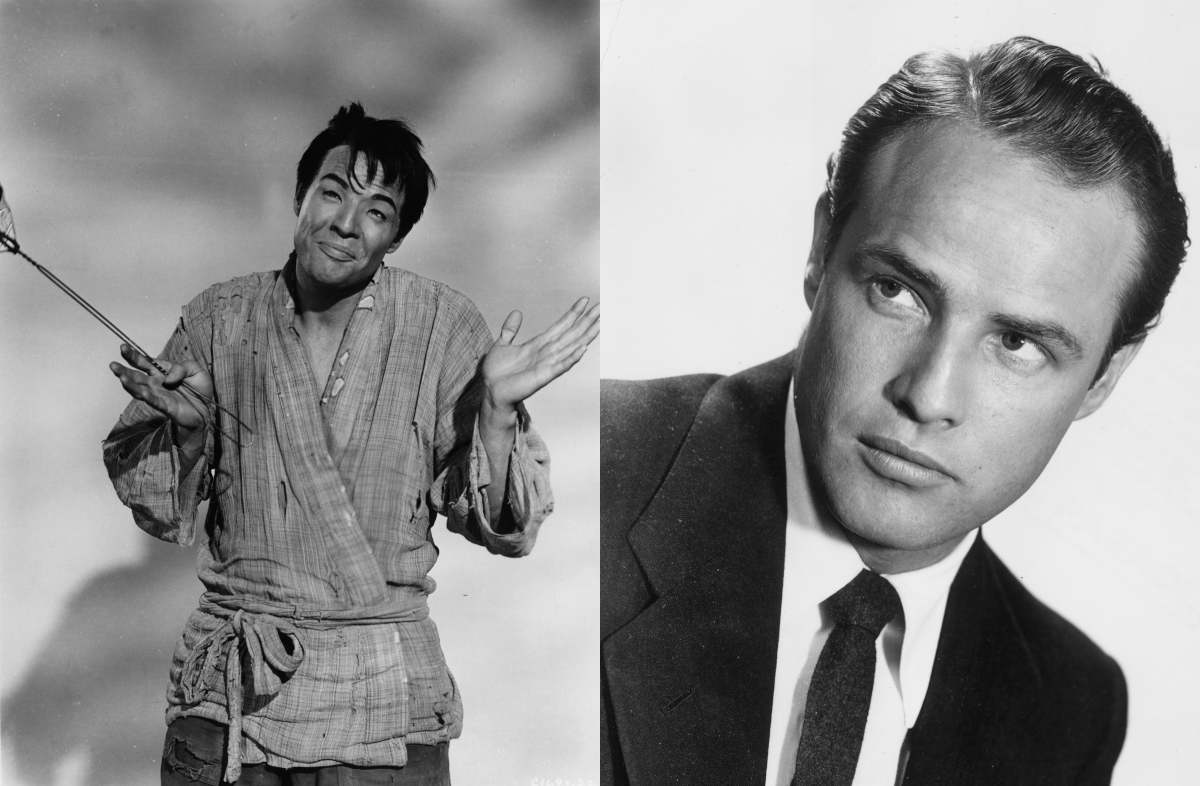
On top of that, Tilda was just distracting and a reminder of how poorly they dealt with Asian culture. Their design felt like the “Asian” section at a Pier 1. She looked a step up from Marlon Brando as a Japanese guy. They did not do anything to demonstrate her “Celticness” or give her motivations for her being there. Why is she bald? Why Kathmandu? Why is she Celtic? How did she become a sorcerer? How the hell did she get to Kathmandu in the first place without dying HUNDREDS of years ago? Why does she speak like a modern English woman? Why are her mannerisms detached from the culture she’s spent hundreds of years surrounded by? Why is there only one generic sorcerer type that uniformly exoticizes Asian culture? Why are all your “masters” white dudes? Why do you have no imagery of the founder of your cult? WHY IS THERE NO MEDITATION?

Doctor Strange should have just dealt with its orientalist foundations and improved them instead of pretending that it didn’t exist. Own your source material and then do better.

Sunday, April 17, 2016

IAA – P2: Pan-Asian Culture in American Visual Media – Dr. Strange v. Firefly v. Kung-Fu Panda 3

I mentioned this in my inspiration post that there were two roads towards this section of the blog. The general one being in reaction to JK Rowling’s mishap with Native American and Caucasian American History and the second was watching Kung-Fu Panda 3. The two are related via the trinity of influence, adaptation, and appropriation because although I enjoyed Kung-Fu Panda 3, I also wondered why I felt more comfortable with their use of East-Asian culture than I did with Firefly. And then the Dr. Strange trailer had to drop. And I was like well…this just stirs up a bunch of mixed feelings. So I’m going to write about how each of these different visual media fairs against the IAA scale. 1 being not too X, 10 being way too X.

Firefly/Serenity (2002, 2005)

What: One of the most beloved, and slighted, science fiction shows known within western culture and Science fiction fandom. Essentially a space-western, except everyone swears in Chinese.

How is it related to Asian culture: Everyone swears in Chinese and there are some signs at one point apparently in Chinese. There is also clearly Asian influence in some costume designs

What initially made me concerned: Everyone swears in Chinese, and in the movie there is some clear influence East-Asian pop cultural references. However, there are no main characters that are Asian in the crew nor can I remember ever seeing an Asian person actually in the show.

Influence: 4

Appropriation: 7

Adaptation:2

Why: There are clearly Asian influences in Firefly, the name of the ship and the clothing styles for Inara, they also even use Chinese as a language to swear in. The problem with all of this is the lack of actual Asian representation in the show. As much as I enjoy the diversity of Firefly, especially the number of highly capable women and the representation of Afro-Caribbean/-American actors, there are no people I can remember in the entirety of the show who are actually Asian. There are like a billion characters that draw from American “wild west” tropes but none that are actually Asian, even for use in stereotyped forms (ninjas etc.). You get an English gangster but not one Asian one. As much as I love Firefly, and the idea that these COULD have been developed had the show continued, that’s still no excuse for the lack of Asian representation in the first season. Even the movie doesn’t do much to further rectify the problem, the villains of the namely Empire still don’t represent the culture that they are supposed to be from. The problem with this, having the aesthetics and the language without the physical representation, is, as I addressed in the first blog, that those cultural behaviors are rarely expressed without people. Goods can travel, but language requires regular speaking contact and we can see even in America’s own history that when Asian cultures are present in the Wild West, which they were, they bring their language and a whole host of other cultural traits. To create a future based on this blend without the actual people makes it rate high on the appropriation scale.

Kung-Fu Panda 3 (2015)

What: The third installment in a series about a Panda who does Kung-Fu. It is set in a mythical China where there are no humans and all animals are anthropomorphized. Everyone eats vegetables and there is no cannibalism of other species.

How is it related to Asian culture: The story is about Kung-Fu and set in China.

What initially made me concerned: Why are none of the major voice actors of Asian descent? Is it accurately portraying Chinese cultural traits?

Influence: 10

Appropriation: 3

Adaptation:10

Why: Kung-Fu Panda has a lot of things going for it that make it more on the influence and adaptation side than appropriation. The biggest probably being the fact that Chinese studios are actually involved in the making of at least number three. However, as much as this helped to maintain the authenticity of the foods and aesthetics, and even a Chinese version of Kung-Fu Fighting at the end, there are aspects of the movie that rate along appropriation. For me the biggest problem is that the major speaking roles, except Oogway, are all voiced by Caucasian actors. While this is a kids’ movie, and when it is dubbed anyone could speak the role, it’s frustrating to see an almost stereotypical representation of Chinese culture voiced by a Caucasian man. While Jack Black is admittedly hilarious, and the movie is fun, it’s bothered me that as the franchise has continued Lucy Liu and Jackie Chan, who voice Viper and Monkey, are continually sidelined for additional quips by the male comedians who are often, in this context, not that funny. So even though it’s definitely adapted, animals for people, heavily influenced, it still gets a rating of 3 for appropriation.

Dr. Strange (2016)

What: The most recent Marvel solo movie about a brain surgeon who gets in a car accident and is unable to perform surgery who goes to Tibet/Nepal to find himself after his accident/surgery. Finding himself included finding magic

How is it related to Asian culture: The entire premise for his “magic” centers on Eastern Asian philosophy and in the original comics he learns from a 500 Tibetan Man how to harness powers based on these East Asian philosophies and magic.

What initially made me concerned: A many Doctors and Surgeons in the United States are now of Asian descent and it would have been the perfect chance to ethnicity swap a major but not super critical Marvel character. While the did not do this to the good Doctor himself, they did gender swap (which is positive) but also ethnicity swapped the teacher of Dr. Strange to being white.

Influence: 7

Appropriation: 7

Adaptation:1

Why: Dr. Strange is a strange Marvel character and like Thor represents an aspect of Superheroism that is sometimes hard to reconcile with ultra-modern technology and people with genetic mutations. However, it also made a lot of sense at the time it was written. The problem is that the movie did not do anything to rectify this very historically contingent use of Asian culture. And to a degree they made it worse. The basic premise for Dr. Strange is that a highly successful Neurosurgeon, who is basically a giant jerk, gets into a car accident and the surgeon who reconstructs his hands is unable to make them steady enough for Dr. Strange to go back to surgery. So goes on a quest to figure out who he is and where does he go? Tibet of course. Which is where he eventually learns the arts of astral projection and mysticism. Yay! In the 1960s having that be a white guy made sense, in 2016, personally, I think it would have been better to cast an Asian actor (who goes back to examine his heritage during a time of crises and builds upon the fact that many in the medical field are not white). Anyways, in the comics, he learns from a 500 Tibetan man how to do this. Well, who gets to be that? Tilda Swinton…Well that’s ok, I’m happy that it’s a woman. I’m not so happy that the implication that Tibetans 500 years ago were white, or that an Ancient spirit decided to live in Tibet and choose to be white, or the implication essentially that Caucasians are better at being Asian, or the idea that Marvel couldn’t write a good movie-worthy Asian character. None of those things are good and so as much as Dr. Strange is influenced by Asian culture, it didn’t do much adapting, and instead decided to appropriate.

Thursday, April 7, 2016

Influence, Adaptation, and Appropriation: Part 1 – The inspiration

At the beginning of March in response to a pop-culture piece, the specific one I can’t recall it may have been J.K. Rowling, I posted the tweet:

Pan-culturalism and appropriation in the "future": Dealing with using cultural designs and culture in Sci-Fi worldbuilding

And one of my friends, suggested I submit it as a panel for Geek Girl Con. So, at the end of March I did with a slight modification to the idea. I retitled it to be the same as the above post and made it more general about using cultures that are not your own to build fantastical worlds. I posted on Facebook about this and people were supportive, both interested in examining this concept and posting ideas for which Science Fiction and Fantasy works should be part of the discussion. Since that time, I’ve been thinking about this topic (Today’s inspiration being Kung-Fu Panda 3). My primary thoughts being, “Am I qualified to lead a discussion about this?” and the following, “I should really put some of my thoughts about this down.”

I am not a writer of science fiction or fantasy, unless you count archaeological interpretation (zing!). I am primarily a consumer with a little bit more education and a compulsion to write my ideas down. I am also a woman of mixed-race so I have a tendency to complicate issues and investigate them within my more complex experience as a human, adding academic insight where possible and if possible.

So let me unpack my tweet a bit. (Anthropologists love unpacking, maybe because we travel alot) It came in response to the use of another culture by someone who was not of that culture to create a fictional story and world. Not necessarily a bad thing but that person was most likely white and was using another culture for personal gain. This got me thinking about how in science fictional futures there is an assumed blending of cultures where as humans progress through time our distinctions between cultures become more blurred and essentially this only one “human” culture. And following the current world trajectory that future is often heavily influenced by Asian cultures and most often East-Asian cultures. We see this in Blade Runner, Firefly, and the re-make of Total Recall, to name a few examples.

This hypotheses, of a blending of cultures, isn’t too far off. We’ve seen in the last 100 years the loss of much of our language diversity and many issues in anthropology boil down to globalization. There are very few, if any, cultures on our planet that have not heard of or interacted with technology in some way and most “traditional” cultures are still influenced at least indirectly by general improvements in medicine and other sciences. So, it is not far-fetched to assume that in the future, assuming we follow our current path, humans across the globe will be more similar to each other in the future than they are today.

However, how you portray this blending is important. Specifically, all of the above listed examples, and there are many more, do not display the biological blending that is also predicted for our globe. They instead preserve modern racial distinctions and grab the symbols of another culture. And there, my friends, is the rub. There is no example in the history of humanity where you have heavy, and dominating, cultural influence without biological mixing and the problem with not portraying that is it allows modernly powerful ethnicities to take on the cultures of others without giving those people their due.

It is, unfortunately, appropriation rather than adaptation or influence and the relationship between the three is what I will explore in more detail in following posts.