Showing posts with label Feminism. Show all posts

Saturday, November 4, 2017

ConMunity Engagement: Feminist Fandoms p3, Bringing Feminism to Mainstream conventions

Women, people of color, trans, queer, and the rest of us folx (aka anyone who is not a straight-white-cis-het-white-male) are changing the landscape of nerd spaces. Besides bringing new markets, or increasing holds in those markets, we are critiquing the ways that nerd-culture is unhealthy. Specifically, these audiences are not interested in the white nerd boy club that was the standard in comics, and other nerd communities. Instead, we seek to change the behaviors that have made these cis-het-white-male-centric spaces unhealthy. This means not being “one of the guys” but changing fandoms and fan spaces to be explicitly feminist, and I mean intersectional feminist, and respectful of all people. While using the term “feminist” to refer to fan communities is in some ways oxymoronic, as they act a microcosm for the rampant misogyny in society, it is that sort of reform that is needed to re-forge them into healthy places.

As comics became blockbuster films, and as more people have grown up with access to manga, establishing feminism in fandoms is one part of the swing back to a more inclusive market in comics. One of these expanding comics-related markets is clothing and cosplay, full costumes or the “undercover” variety. Because costuming, and the skills required for costuming, is/are still coded as feminine and this work has brought many more women into these spaces.

However, cosplay is not inherently feminist. There is still an association between the term ‘cosplay’ and sexy because it revealed how impractical and bizarre costuming choices for women characters in comics are. This mean that cosplay can embody the same misogyny that exists in the comics that they draw from and that was inherent to the nerd community.

So cosplay brings in more women, as do many other factors, but how do we bring feminism to mainstream conventions when women just as capable of supporting the patriarchy as men? I’ve touched on this in my previous blogs but it involves supporting feminist programming, artists, sellers, and bringing feminism into whatever fandoms you participate in. For me this starts at home. Am I being a feminist consumer? I try to be and you can read my rule about buying floppy comics to see what I mean. Some people argue that the idea of a “feminist consumer” is problematic because of the rise of “capitalist feminism,” which some people see as antithetical to the goals of feminism . However, conventions are essentially small open markets where the consumer has a lot of power. It’s also the age old claim of the anti-diversity folks that we “diverse consumers” just aren’t driving the market. So it’s paper paper paper to support the diverse work I love.

Sometimes you love what you love, and sometimes that thing is not easy to reconcile with feminism. My example is Star Trek: The Original Series, I love so much of what it brought to the small screen, but its approach to women and culture is still deeply rooted in the 1960s (for an example revisit The Paradise Syndrome). If the fandom you love has problems that deal with culture, gender, sexuality, or race, consider bringing programming to conventions that addresses those issues. We are at conventions because of our love for the medium, genre, or specific work so if you feel like it needs to be critiqued, you are probably not alone. There will be other fans interested in having a meaningful discussion about intersectional issues, if you didn’t enjoy it so much, you probably wouldn’t be annoyed enough to want to critique it.

My last suggestion is to wear your feminist properties on your sleeve. Be open about it, take up space and be seen supporting properties like Feminist Frequency, Black Girl Nerds, and InSEXts. Encourage your friends to support new feminist properties or bring them to panels that support those creators. Wear your Bitch Planet pins to the con, out in the world, and talk-that-shit-up. One of the biggest comments I’ve gotten after talking to people about Bitch Planet, is “I didn’t know that existed in comics” WELL NOW YOU KNOW. Go do the thing. Also, where possible, don’t take shit from people trying to gatekeep you. Assert yourself, ask questions like “why does that matter?” and interrogate them about their knowledge. I have had to explain my “Feminism is my Fandom” pin more than once but that meant that the other person actually had to engage with what that meant. Part of the patriarchy is controlling knowledge, power, and knowledge as power. We can do it too, it's just a matter of using those tools to our advance our agendas.

These are just a few suggestions but it’s clear from the existence of sites such as themarysue, youtube series like Feminist Frequency, comics like Bitch Planet, and films like She Makes Comics (PS don't believe the IMDB ratings, they're heavily gendered) that feminism exists in nerd spaces. Each of these celebrate women’s long history of participation in the nerd community and demonstrates how feminism benefits both women and men and conventions. It means that people, regardless of gender will have respect and be able to participate in the things that they love without fear of bullying or discomfort. We all attend conventions because they should be safe spaces and to make that true requires feminism and feminist fandoms.

Wednesday, October 25, 2017

ConMunity Engagement: Feminist Fandoms p2 More than "Women in Comics"

This blog comes in response to a tweet from yesterday:

GeekGirlCon, its existence and its success, demonstrates how unnecessary and belittling the “Women in Comics” panel is. There are women creators throughout the industry, you can have an all women panel that does not center on gender identity. It’s gotten so absurd that some (perhaps many) women creators no longer accept invitations to be on such panels.

But how do you fix this Paulina?

Easily, by not being dumb. Also by having panels that reflect the reality of the industry aka changing from manels (man-exclusive-panels) to all gender panels or by picking topics other than “what’s it like to be a woman” to have a group of women talk about. All of the panels I have organized have been all-women panels and none of them centered on gender. It’s possible I promise. Now go think of some.


Haven’t thought of any? Here are a few I thought of in the last thirty minutes, with full panelist rosters and links to those creators:

Witchcraft and Wizardry in Comics

Short Description: Magic is a regular theme in comic books. What are the commonalities, what are the differences, whose magical inspiration do you draw from, and why do you think this is such a powerful method for storytelling.

Suggested Panelists: Kate Leth, Ming Doyle, Wendy Xu, Caitlin Kittredge, Nicola Scott

Epic Romance in Comics

Short Description: Love is a driving factor for many characters. Let’s talk about some of the epic romances that have taken place in comics and how that acts as motivation for all sorts of events.

Suggested Panelists: Marguerite Bennett, Ariela Kristantina, Fiona Staples, Catherynne M. Valente

What does it take to be a hero?

Short Description: Comics are filled with heroism. Whether they are people with superpowers or people who just want to do the right thing. Why is this a theme people want to keep reading about and what defines a hero in comics?

Suggested Panelists: Kelly Sue DeConnick, G. Willow Wilson, Mariko Tamaki, Gail Simone, Roxane Gay

The Final Frontier: Space as setting

Short Description: What does it mean for a piece to be set in space? Why does space as a concept and as a place tickle our storytelling senses. What do we agree exists in space and what do we debate? How does real science and astronomy play into these ideas? Can we consider "space" to be a character in its own right?

Suggested Panelists: Kelly Sue DeConnick, Nicole Perlman, Marguerite Bennett, Dr. Chanda Prescod-Weinstein

Hometown heroes

Short Description: Sometimes the problems we face aren’t going to affect the world but they do hit a close to home. Who are these hometown heroes and where do they come from? How does reading about solutions to day-to-day problems help us learn more about being good citizens and people.

Suggested Panelists: Brittney Williams, Hope Larson, Pamela Ribon, Kiku Hughes

Road Trip!

Short Description: Every day thousands of us end up on the road. So what defines a road trip and what is it about those events that make them great for storytelling. Are there tropes on the road trip or is it just the heroes journey. Can you have a road trip without roads?

Suggested Panelists: Kate Leth, Shing Yin Khor, and Megan Levens

What these topics prove are that in most cases, any panel you could staff with all men (particularly if it’s all white-dudes) you could staff with all women. You might need to tweak the topic slightly, if you happen to have picked a historically sexist topic or maybe just one that’s always been done by white-dudes (google writers of Superman), but if that’s the case maybe don’t have that panel or have a bigger name woman moderate it. Women have been a major part of the comics industry since it’s inception, it's time convention-panels reflected that.

Tuesday, October 17, 2017

ConMunity Engagement: Feminist Fandoms part 1

I like millions of other people went out on 21 January 2017 to participate in the Womxn’s March. Though I already had my feminist apocalyptic-chic outfit chosen my friend and I sat down to make a sign each and I chose the simple NC from Bitch Planet. I’ve started to use this as a sort of default for creating things now, aka there is only one Halloween pumpkin design, which seems both ironic and appropriate. If everything is non-compliant then it means nothing (there is no compliance bar) but it’s also a simple and powerful symbol. I knew there were probably many other non-compliant womxn out there at the march but I was not in a large city, so I got a few questions about what “my symbol meant” but that meant I got to share more about Bitch Planet.

I like the many other people with fantastic, empowering, and sometimes hilarious signs, I chose NC very deliberately. I chose it because I wanted to showcase my particular brand of Nerd-feminism and to highlight the simplicity behind the idea of non-compliance. One of the reasons I love Kelly Sue and Val’s concept is because non-compliance can be simple or complicated, many or one thing. It simply does not comply. And when I talked with people about the concept it made them think about the millions of things that women are taught that make them un-feminine or can feminize a man. That simple concept can apply to anyone and makes this comic-book-based-feminist idea so powerful. This is also why I chose to fill in the letters with pink and black. For me the use of the color pink is associated with femininity. I had growing up disliking pink and disliking many of the other associations with femininity that came along with it but as I have gotten older I’ve become more welcoming and almost fiercely attached to pink. I’ve taken it up again and paired it with black because it is a color of resistance and power. Black helps connect us to other, and greater, movements of resistance.

What I also like about the symbol is that Bitch Planet is part of a feminist movement in comics and in Fandoms, which have the potential to be feminist havens. For me the intersection between my nerdy interests and feminism was another way place that feminism has to be entrenched. For me, my nerdy interests need to be feminist. Not all fantasy has to help us to be better people but as tools for teaching, it is integral to making us our better selves. Also for so long being a nerd was almost exclusively coded as male and what more recent fandoms have done, by the increase in cosplay and crafting, is incorporate women and transform nerd-dom visually, emotionally, and intellectually.

More than ever at conventions, particularly at conventions like GeekGirlCon, I see people talking about mental health, inclusion, and a myriad of other issues that have made nerd communities more inclusive and cognizant of society’s problems. Before Nerd-dom has a history of being welcoming to women but it, like many professions, has gone through an anti-woman hump that only recently has had a fierce and purposeful restructuring. This has involved opening nerd islands of insolation and discussing how even nerd friendships were unhealthy. Controlling nerd knowledge was just a different form of bullying.

The increase in the number of women and women’s spaces in Nerd dom has meant a re-negotiation of these behaviors. While some have turned from bitter nerds into members of the alt-right, those same feelings of alienation can be used to unite people against the things that reject us. Being part of a persecuted group does not exclude you from negative behaviors but we have a common enemy and those are hate and feelings of loneliness. Additionally, so many works of fiction that create fandoms, whether or not they identify as nerds, are built on ideas of being true to one’s self, cooperation, and resistance to negative forces. Because of that intersectio-nerd-feminism is a must.

For me, nerd-dom is linked to my interest in science-fiction and “nerdom” because it has in many ways helped me formulate and understand my identity. It is a community I participate in and it must be held to the same standards that I require of the rest of the world.

Wednesday, October 4, 2017

ConMunity Engagement: GeekGirlCon a Feminist Convention

Another weekend and another whirlwind trip to in the Pacific Northwest. I may have been perpetually tired but GeekGirlCon did not disappoint. There was a great collection of artists and the panels were as impactful and important as I could have hoped. GeekGirlCon always leaves me with a lot of feelings. Most good but a few that make me want to push for more from the convention but I'll talk about that later.

GeekGirlCon is a unique convention held in Seattle for the last six years. As a 501(c)(3) (aka a charity) organization the convention is organized by volunteers except for their one paid employee, the executive director. They only were able to hire an executive director this year as what started as a small convention has grown over the years to fill more and more space in the Washington State Conference center.

Unlike many other conventions, it has the mission of inclusivity meaning “ALL ages, gender identities, sexual orientations, sizes, abilities, ethnicities, nationalities, races, creeds, religions, familial statuses, physical and mental abilities, alien species, earth species, education levels, science specializations, operating system preference, fandoms, etc., are welcome.” As defined by themselves. This definition for inclusivity means that their goal is intersectional feminism centered on a geek community.

Last year was a great introduction to the set up and so this year I was more selective. I attended only three panels, besides my own, and my favorite was #BlackWomenDreaming with some of the amazing writers from Black Nerd Problems. The panel was a fantastic introduction into creating your own working, supportive, and accountable creative community. Some of the highlights included: be honest when you give criticism and when you talk about your goals, reach out to people to create your community, and make sure to keep our eye out for opportunities to one another. There were a ton more great moments from the panel but overall it captured the best parts of GeekGirlCon by highlighting the voices of women of color and the outlining ways that we can promote a healthy geek community.

Besides panels, I got to meet up with some old friends and make some new ones too. Ran into my friend Hannah dressed as the awesome Liv Moore from iZOMBiE and caught up a bit. Was ambushed by my friend Carrie, who was a panelist for me last year and who was part of the #BlackWomenDreaming panel. Saw the amazing Tristan at their table and on my panel. I also got to meet Kiku, Symantha, and Sarah who were all fantastic on the panel I moderated (I’ll talk about that in a forthcoming blog). I also introduced myself to a few more people who I may tap for panels for Emerald City. Also my mom came and was at my panel. She was a very fantastic typical mom who is not versed in Geek stuff but seemed to enjoy it nonetheless.

GeekGirlCon is fantastic for being one of a handful of feminist nerd conventions around the world. It promotes girls of color in STEM by having them on their imagery and donating passes to organization such as Con or Bust, which helps People of Color / non-white folks attend conventions. The majority of their speakers are women, non-binary, or trans folks and the content of panels at the convention really brings that inclusivity home. It highlights professionals from those groups in gaming, writing, art, illustration, crafts, voice-acting, science, industry, and other fields. It shows not only women as characters but highlights the importance of women as do-ers and creators, demonstrating how girls and women can decide the narrative and their lives.

This con is extremely valuable in this regard as so often, conventions are coded as male-centered spaces and sometimes, even as extremely unhealthy male-centered spaces. GeekGirlCon contrasts that by specifically trying to build positive community and to highlight topics of discussion, through their programming, that would be considered a side-issue at larger conventions. However, GeekGirlCon is not perfect and I’ll talk about that in my next blog on why Representation at Cons matters.

Sunday, August 27, 2017

Guardians of the Galaxy Vol. 2 Redux

I really like the Marvel Cinematic Universe’s Guardians of the Galaxy (GOTG). I read the run of the GOTG series written by Brian Michael Bendis leading up to and after the movie (ending at 27 before Secret Wars)and it pales in comparison to the characters set up in the film. Other iterations of the Guardians, before and after that run, have had the same problems and particularly those that came before it fall into the unfortunate trap of so many comics from that era, everything centers around the white male experience, and any character that can’t be coerced into that form basically has no character to speak of.

However, when I originally left the theater after GOTG vol. 2 I had a funny feeling and I couldn’t quite figure out why. I liked the movie but didn’t love it the way I had the first movie. What was it? Was it that I didn’t laugh as much? Was it because of the insulting nature of Drax? Was it that almost everything Gamora said started with a No? Was it the soundtrack? Was I hungry during the film?

I let the movie go for the summer though, letting it settle into the back of my mind and not questioning the hesitant positive feeling I had about the film. So when Clara Mae’s article exploring the misuse and abuse of Mantis in the film came out recently, I knew I couldn’t let that rest any longer. I knew I had to re-watch the film and knowing about the twist, and remembering some other low moments of the film, to try to pinpoint what it was exactly that create such a funny feeling.

Upon re-watching, which I did at a theater so I didn’t tweet through the whole thing, I enjoyed it. It was a good movie with a solid theme that someone on twitter put succinctly, its about living with your family. Obvifously, that’s not a hard theme to pick up on. Everyone has their “travel through the Galaxy” buddy and very rarely do we see any of the characters alone at any point in the film. With the exceptions being some great character shots of Starlord and Gamora.

But the movie falls short of fully developing this idea particularly failing in the humor and in the portrayals of relationships that involve women. Gunn has done a fantastic job dealing with issues of fatherhood. Rocket and Groot, the Daddy triangle of Starlord, Yondu, and Ego; and even Yondu’s relationship with Stakar (Sylvester Stallone’s cameo character) but when it comes to relationship with women of the story, it falls flat.
Mae’s article describes the misuse of Mantis and explores the character in relation to her comics inspiration in more detail than I give here but in general it made me ask the question, what, if anything, is actually funny about the interactions between Drax and Mantis? I think they were trying to go with a sort of “tough love” relationship and I appreciate the idea (not the execution) that Drax has a different conception of beauty than the implied “norm”. (Side note: Personally the apparently common beauty standards, gender categories, and romantic relationships in an infinite galaxy in the MCU and elsewhere gets old and for me feels extremely unimaginative but I digress). There’s a difference between being honest and being rude. Drax even acknowledges that Mantis is naïve and yet continues to insult her. He knows what insults are just because he might not understand metaphor. Also while apparently naïve, Mantis knows what she looks like and what she likes to look at, so it’s very unlikely that she has no conception of what “beauty” is. I do appreciate the idea of having a beautiful soul but it comes at odds with other things that Drax says. He talks about how ugly beings know that they are truly loved because people can’t just enjoy their appearance but at another point talks about how beautiful and attractive his own wife was, who he clearly loved but maybe she didn’t trust him to have done so truly.

Other interactions with Drax, who for some reason carries the majority of the comedic load of this movie, are particularly unfunny. The jokes in the film seem to have devolved from amusing and cute non-sequiturs, such as the “I'm Star Lord Man. Legendary Outlaw” line in the beginning of the first film, to literal poop jokes and extremely predictable physical gags. The consistently mediocre humor dragged down the film. I assume Gunn was trying to link such intimate details, the sort of things you only talk about with family, to establish the relationships that the Guardians have built since the previous film. However, there are other ways to do it especially this isn’t a G rated movie where toddlers are looking for fart jokes to giggle to themselves. Also because there are other moments that execute this idea more clearly and more meaningfully. Peter mention that he told Gamora a drunk story and Rockett’s continued references to wanting to listen to “Peter’s Music”. These details build the relationships without the need for cheap laughs or insults and is the sort of meaningful reliance on family that the movie is trying to portray.

Without the jokes, much of the portrayal of family as theme works really well and there’s a lot of good self reflection on the nature of family and what makes beings bond.

I also have to say that the movie does a pretty great job (and sort of in parallel to but also intersecting with) critiquing the idea of white male exceptionalism and superiority. The fact that an exceptionally powerful being when they conceived of what biological life (in general) would look like, he selected a humanoid white male says a lot. While it may have been unintentional on Gunn's part as the character was created in 1966, it says a lot about who has power and who we imagine as powerful in our culture. But acknowledging something isn’t necessarily a critique Paulina! Yes. That is true. BUT that comes with the fact that the character is named EGO, encompassing the essential nature of the character also as the quintessential non-reflective cis-het-white man. This metaphor can extend to all the other characters in the film too, who by the end of it work together defeating their own egos to be successful in defeating the big Ego. This critique is also confirmed when Peter retorts, “What’s so bad about being like everyone else?” directly confronting the idea of the inherent exceptionalism of white men and then Peter rejecting the idea of being divinely special.

This whole thing is great. However, all of it basically centers on the white male perspective and while a critique, it doesn’t back that up by bolstering its use of their none-white male characters. It is a self-critique of the white male perspective rather than an expansion of that critique in application.

This shortfall is of course most evident in the woman characters. (Side note: Michelle Yeoh is the only women of color in the film who is not in make up.) This comes across as most problematic with the two most prominent woman characters, Mantis and Gamora. Specifically Mantis, literally performs the emotional labor for the team, and Gamora, for most of the film acts as a “no” woman.

Empathy powers are not out of the ordinary for Mantis as a Marvel Character however, it means that she literally embodies performing emotional labor. Her job is emotions, changing other beings emotions or using them to transform her own. The entire final battle, to give time for the rest of the Guardians to come up with a plan to defeat Ego rests on her empathic ability. The scene demonstrates how powerful Mantis’ powers are (though it’s undercut by Drax’s unneeded commentary). But it is the physical embodiment of learning to use her emotions and empathy for the benefit of others at the expense of her physical safety, which is also used for a cheap joke. This is also not given as critique, it is demonstrated as a gift, the thing that makes her special and unique. It doubles down on the idea that the emotions of men come down on the shoulders of women.

Gamora, rather than being sympathetic to Mantis essentially treats her as a non-entity, although they both should have a lot in common considering they both (along with Nebula) were manipulated and enslaved by powerful males. This commonality is not explore of course (though I would also love a Guardians with Nebula, Gamora, Mantis, and Michelle Yeoh) and instead the more prominent role Gamora takes in the film is as another stereotype, the “No” woman. If I’m honest, I love Zoë Saldaña particularly as Gamora but the only Marvel product that’s really done anything to give Gamora a full character is Nicole Perlman’s short-run comic entitled Gamora (WHICH TOOK FOREVER TO COME OUT AND THEN ONLY RAN FIVE ISSUES AND I AM SAAAALLLLLLTTTTYYYYYY about this).

Both movies have some great Gamora moments but she rarely comes across as a full character and often she gets relegated to a slightly more emotive Drax. But I digress, the most unfortunate thing that happens with her character is her status as the “no” woman of the group. She’s the Hillary to the Starlord Bernie, shooting down all the male characters ideas and getting to basically mother the group. It is a valid personality choice if it wasn’t such a goddamned trope for smart and capable women. What is a “now” woman? Well they essentially act as the curb to the grand ideas of men. They are practice, realistic, and rarely seem to have inventive ideas on their own. Generally, and what are then figuring is their conservative, interactions with the inventive, impractical (cis-het-white) male character. Gamora, admittedly isn't always a “no” woman in the film, as she is the whole reason Peter takes a chance with Ego but in that she basically only serves to further the white-cis-het-male plot and up until that point almost every one of her lines begins with a “no” or a negative statement.

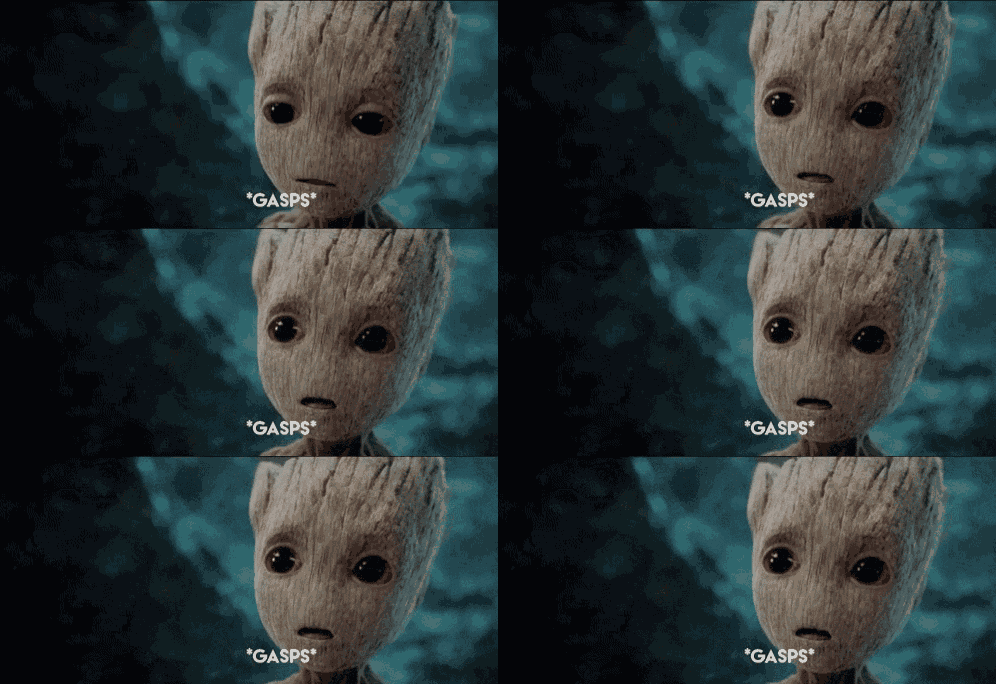
Paulina after so many paragraphs of critique how could you say that you actually enjoyed this movie? It has so many problems. Well my dear readers, everything I love this problematic, from my dog to my chosen profession. The film has some excellent points, is lusciously shot, and designed. Baby Groot is fantastically cute and the songs fit well with their associated scenes. Also the points that the movie gets right are fantastic. Also needless to say the portrayal of the Sovereign as the embodiment of “whiteness” upon re-watching is fantastic. Yes a couple of the attendants to the High Priestess are people of color but the majority of them were white, and their entire culture screams stuffy white people especially with all their gold and high and mighty attitude. And of course the super creepy “construction” of perfect individuals and their controlling of their entire world. Anyways it was good but because of the unfortunate single-mindedness of the creation wasn't great. It is a fantastic treatise on white-cis-het-male relationships and critiques them but doesn’t take those to the next level. It remains in that world rather than expanding the repercussions of that critique to impact the agency of the other characters. Assuming we get a vol. 3 and on the results of the Infinity War films, we will probably be exploring the idea of losing or living without one’s family and I hope Gunn brings in another pair of eyes to critique the script based on problems like this to give meaning to the myriad characters that are now part of the Guardians team. Yes, there is a lot we can critique cis-het-white-males for, but the real end results of that should be giving agency to those who are not that and letting their diversity and personalities shine through.


Sunday, August 20, 2017

There's more, I promise

Hey! So this still exists and I'm working on a lot of blogs right now that will hopefully make for some entertaining reading over the next few weeks/months. Summer got the best of me so I didn't get to develop some of the ideas I had at the start of summer into real blogs.

A quick preview of what's to come though:

  • Something on whitewashing and stereotypes in movies/TV (I'll let you guess who'll be the subject of that :D)
  • Me discussing Marvel's 1,000,000 BC line which explodes my brain
  • A set of posts on community engagement and conventions
  • An examination of Feminism in Fandoms
  • Some comics recommendations

Also, not 100% in that order as some of those topics require a bit more work than others to fully articulate into meaningful things that I want people, or bots or whatever stumbles upon this, to read.

In other news, I will be moderating two panels in the coming months! One at Rose City Comic Con in Portland and another at GeekGirlCon in Seattle. They are part of the community engagement at conventions I am/was/will be talking about because what's all this PhD learning for if it just stays in the Ivory Tower? I'm a Scientist not Rapunzel!

The panel at Rose City Comic Con is entitled "Adaptation versus Appropriation: How to borrow respectfully from other cultures in fiction" and will be on Sunday, September 10th at 1:30pm, in Room 8. I got some awesome people to participate including Tristan J. Tarwater, Yoshi Yoshitani, Jemma Salume, Marissa Louise, and possibly one more person who is not sure if they are coming yet. It's a simialr topic to the panel I ran at GeekGirlCon last year but with a new crop of people and at a larger convention. Join us if you're in the Portland area.

Panel 2 is at GeekGirlCon and is entitled "Scion or shafted: Being mixed-race in science fiction and fantasy cultures". This one is also on Sunday but this time October 1st from 3:00-4:00pm. I also found some great speakers for this one including Kiku Hughes, Tristan J. Tarwater, Symantha Reagor, and Sarah Gulde. If you are in Seattle around that time please come to GeekGirlCon and hear us talk about this awesome stuff.

I'm hoping to be a panelist at Emerald City Comic Con in the next year as well with Miles Greb and a few others. We're hoping for it to be a sort of Science Fiction/Science Fact thing with creators and associated scientists both being part of the discussion. That's still in progress and I hope it goes through.

Anyways, thanks for reading, and I hope next time I've got something a bit more meaty for you to think about.