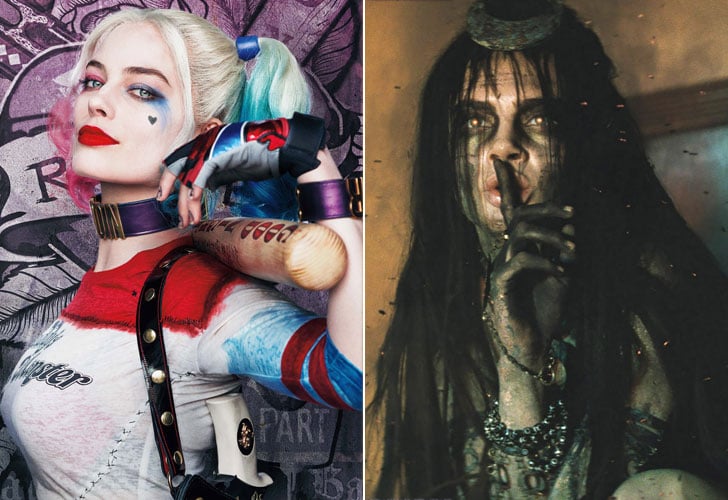
So a while back I watched
Suicide Squad. You may have seen my
tweets. Now a few months removed I remember it as generic, at points boring, and very poorly constructed, with a cast full of character that did not, in any way, need to be there. It was an ensemble movie for the sake of ensemble movies. However, I was surprised to find myself really enjoying the special effects for Enchantress who, spoilers, turns out to be the villain. Which is as a concept was pretty cool. Ancient deity plays stupid government who thinks they can control it. I can dig it (ha terrible archaeology joke). But beyond that, and the thing that I kept coming back to the longer I’ve been away from the film, was the fact that the Suicide Squad has not one but two women Doctors, Phds in fact, on their team. This of course fascinates me because I too will be a doctor and graduate school has a special fascination for me as someone going through the process.
In relation to the movie, Dr. June Moone’s degree is integral to the plot, as a driver for why she becomes Enchantress, while Dr. Quinzel’s is not. However, they both end up on the wrong side of the law, or at least Enchantress does. Side note: There is some debate about whether Dr. Moone has any say in the issue. Personally, I think she does and for the same reason I dislike the idea that all bad people are necessarily mentally ill or unstable or for a more “biblical” explanation are possessed by evil spirits, in some people it comes down to choice and some people do choose to do bad things and we can’t always blame it on things out of their control. In this case though, I don’t think it’s clear that Enchantress is necessarily doing anything wrong, how would you react to being trapped in a ceramic totem for thousands of years, and I don’t like the idea that Dr. Moone is just a vessel as that removes all of her agency. I don’t know how they play it in the comics, as honestly DC hasn’t sold me a on a floppy in years, if ever and her origin story there is actually as an artist, but I think Dr. Moone is there and pissed too.
Anyways, regardless of how important their particular degrees were to the plot, this is a team that consists of very educated women with essentially “common criminal” dudes. Why is it that, at least in this case, smart women and uneducated men are the villains? What does that tell us about gender in the world of DC? This is not to say that all men villains, or women heroes, are dumb or uneducated, merely that when you have a fully formed woman villain (in character) she is often smart and there is diversity in the portray of good and bad men and good women.
For me, that then becomes a question of why. Why are women villains so smart? One explanation is that these are metaphors to undermine smart women. That essentially at one point a woman learns too much to be considered a “good” or “heroic” woman and then necessarily becomes bad because women cannot be naturally bad in the same way that men can. There is also a clear history in many cultures of perpetuating the idea that smart women are not good women so it’s not surprising that this comes across in fiction.
For me, regardless of where this concept came from, if we accept the premise that being smart, or becoming educated, has something to do with becoming villains there are a couple of different roads that can lead down. There is of course, liked explored above, the idea that smart women are naturally bad, regardless of if they were inherently smart or received education. But this “essential” quality doesn’t do anything to inform characters and while not all fiction has to be an in-depth examination of the psyche, well-developed characters often come from something and this is particularly true of villains. So if we look at the idea that it is not essential or innate but instead that there is something about being smart or becoming educated that transforms smart women into villains, what systems of oppression or bigotry or misogyny compel smart women to believe that lawful actions are not the just ones or at least not ones that lead to their desired outcomes.
This runs into an issue plaguing many comics and because of DC’s growth from Detective Comics, "heroes" beating up people doing petty crimes, they seem to have suffered the most. Many people still believe in the idea that most criminals do “bad” things because they just do or are inherently bad. However, as we have learned more about the causes of poverty and criminality, de-coupling them from culturally assumed ideas about predispositions or heredity, most smash and grab criminals, like those presented in Suicide Squad, and particularly if they didn’t have powers, become less “evil” and more clearly products of structural violence. In some ways, understanding that makes one feel like there are no real villains that didn’t have a good reason for doing so, at least when it comes to the street criminals that are in many comics. With one exception in Suicide Squad, that being the Australian Bank Robber dude whose name I forgot. All the other men characters are products, to greater or lesser degrees, of structural violence and any heroes that we see *cough* Batman *cough* end up playing the role of the white-status-quo-bourgeoisie savior. He’s not saving Gotham, he’s saving an idea of a system that helps to oppress minorities and thrives on their exploitation. If those are the systems that created villains like Deadshot then what systems of oppression may have pushed women like June and Harley?
Obviously they are not the victims of race-based structural violence, being white women, and they probably had quite a bit of power in their lives to be able to pursue PhDs at all all, so what changed? What shifts an affluent white woman from the cogs of the wheel of oppression to being squashed or feeling squashed under that wheel?
Is it, in fact, the academy? I think it is and particularly because academia is in a unique situation where it both perpetuates systems of oppression and gives people the tools and knowledge to dismantle them.
How does the academy perpetuate systems of oppression? Well, almost everyone who has done graduate work will not need me to tell you. But I will because this is a blog. We can look at the fact that most academic departments are still comprised of cis-het-white-men most likely from middle-to-upper-middle class backgrounds meaning they dominate what we can call the “academy” and essentially are the academy. This is not to suggest that such people cannot promote diversity, many of the people who pushed me into graduate school were such dudes, but when you see incoming classes of graduate students who continue to reflect what came before them you, begin to wonder if they are actually doing that. Also while college education helps to level the educational playing field, studies demonstrate that college makes the field less lumpy but it is by no means flat. Those with privilege tend to be more aware of the resources available to them and continue to succeed even more, standing on the shoulders of giants. While those who do not enter with that privileged knowledge, do not enjoy additional resources and don’t get anymore help.
However, something that the academy, and education in general, are also good at doing is opening the eyes of students, at least with good professors and teachers, to witness and recognize systems of oppression. In many cases, giving students the tools to recognize what is wrong in society and the hope of being able to fix it. Education is how you learned about systems of oppression, structural violence, and issues of intersectionality. Or at least you can, it is an option. Not everyone takes that option, which is probably why changes in academia have not been as fast as they should be.
Ok So how does this create white women villains with PhDs? Well it creates a system that will oppress them, a la institutional sexism if they want to pursue work beyond their PhDs or just even conduct their PhD research, and the knowledge about that system to want to fight back. It removes them from the Ivory Tower and places them at odds with the things that created their knowledge and impacts their abilities to succeed as much as their white-male colleagues.
For me that transition is the most interesting part of the stories of Harley and June, outside of current cannon and Suicide Squad as a film. Particularly in the case of Dr. Quinzel. What in your life as a psychologist happens that makes the thoughts of a known psychopath, or obviously bad dude, seem to make sense? I don’t assume that she didn’t already have issues going in, as the show Hannibal likes to portray all therapists have their own therapists, but she knows all about psychological issues, manipulation, and had to go through extensive training for these things. So what changes, what makes the ideas of a patient seem like the sanest perspective. Personally, I don’t find the “she fell in love with him” aspect to really mean anything or allow for much discussion but even if that were the case it still follows this path. Dr. Moone’s path is more complicated because of the issue of, at least in the movie, her possession, which does crazy things with her agency. But if we assume that she has at least some choice in the matter, what changes in her where the ideas of an ancient deity wanting to reign havoc seem like the best possible option.
I have some ideas but I’m not a comics writer. I’m just someone going through a PhD and I can definitely see where any of us might run off the rails, in a world where supervillainy is a thing. Regardless, these titles are not just aesthetic. They imply something about the characters and about our society. They help us to understand their motivations and create richer stories for the public to consume and it does the dual duty, like many comics and science fiction did in the past, of exploring serious social issues in a detached world allowing those who don’t have the eyes to see them in our world explore them in a different one.