Showing posts with label Paranormal. Show all posts

Sunday, April 8, 2018

Mixed-Race Creators, some recommendations

It's been a while and thank you for patiently waiting for the return of these blogs. Awesome and rewarding things have happened since I last posted a blog here (I recently got two articles published over on Women Write About Comics) and to start off the New Year (yes I know it's the beginning of April and past Lunar New Year as well) I'm going to toss out some creator recommendations.

Last year at GeekGirlCon, I moderated a panel on mixed-race characters in fiction. You can see the footage of it here and the tweet/photo above was from the awesome Lauren Bullock who attended the panel. I had a great group of people on the team and between that and the upcoming Alloy Anthology I thought it would be a great time to plug a few mixed race creators.

Tristan J. Tarwater

One of my favorite panelists of all time and an all around awesome person is Tristan. They has been on a bunch of panels with me and is a fantastic writer. They write Shamsee an ongoing webcomic and their book The Marauders' Island was the first physical book I finished reading in 2017 and is amazing. The book is a high seas family reunion in world where land and sea operate as one world and magic traditions are woven into the culture of each place. You can grab their books off of amazon and many local libraries (do a purchase request if you can't) and if you pick up her stuff don't forget to write a review. To find out more about her check out her website and follow her @backthatelfup on social media.

Marjorie Liu

A paranormal and comics writer, Marjorie Liu is fantastic. I really enjoyed her book The Iron Hunt, which was set in a paranormal-noir-modern-Seattle, and would love more audiobooks for her impressive oeuvre so that I could consume more of her work. She currently writes, Monstress for image and is specifically interested in talking about, and to, the experience of mixed-race people. While through allegory (which uses the biological definition of race as opposed to the social concept of race), it touches on the diversity of mixed-race people and the myriad ways we can or have “passed”. You can also buy her work on amazon or get them from many local libraries (do a purchase request if you can't) and if you pick up her stuff don't forget to write a review. You can check out her website for more information and follow her @marjoriemliu on social media.

Julie Fiveash

I met Julie at Indigenous Comic Con 2017 and her work is really cool. She blends the unsettling with the cute (I got a bunny sticker from her that says “Death Awaits”) and was great to talk to at the convention. She had a bunch of zines available (so if you catch her in person pick up a couple) and I grabbed “Why Can’t You-: A comic about multi-racial identity,” which is exactly what it sounds like in the best possible way. It blends 2-6 panel short comics into one plot and goes through the type of interactions that all multi-racial people have gone through. You can follow her work on tumblr, instagram and view her portfolio here.

Yoshi Yoshitani

I had the honor of having Yoshi on a panel with me at Rose City Comic Con to talk about Cultural Appropriation and she is an amazing artist. Her work covers all sorts of topics and what initially drew me to her work is a Tarot deck inspired by fairy tale stories from all over the world. She has an amazing and unique style and recently, she has decided to go full freelance (congratulations) and has worked on a bunch of awesome new covers for Star Trek, Monstress, and other comics. You can find out more about her on her website and buy her work here. To hear more about her upcoming projects and appearances follow her on social media @yoshisquared.

Kiku Hughes

Last but not least is Kiku who was also on the mixed-race creators panel at Geek Girl Con last year. Her ongoing webcomic the Sublimes is great and her graphic novel Displacement is going to be published by First Second in 2019. She also has the amazing honor of being the assistant editor to Der-Shing Helmer on the Alloy Anthology. Check out more of her work here and you can follow her on social media @geniusbeee

One of the best parts about looking for panelists for the mixed-race characters in fiction panel (and accidentally also my #ExpressiveAsians panel at Emerald City Comic Con) has been to see how large the multi/mixed/bi-racial creative community is. Many of us fall into the “ambiguous brown person” (a quote directly from Julie Fiveash's “Why Can’t You-: A comic about multi-racial identity”) category and no matter where we grew up there are some experiences that we all share. And if the works of these creators pique your interest, check them out and follow the the Alloy Anthology website to find out when the Kickstarter begins and to find out about more mixed-race creators.

Sunday, March 27, 2016

PPPs – Part 3 – Comic book adaptations

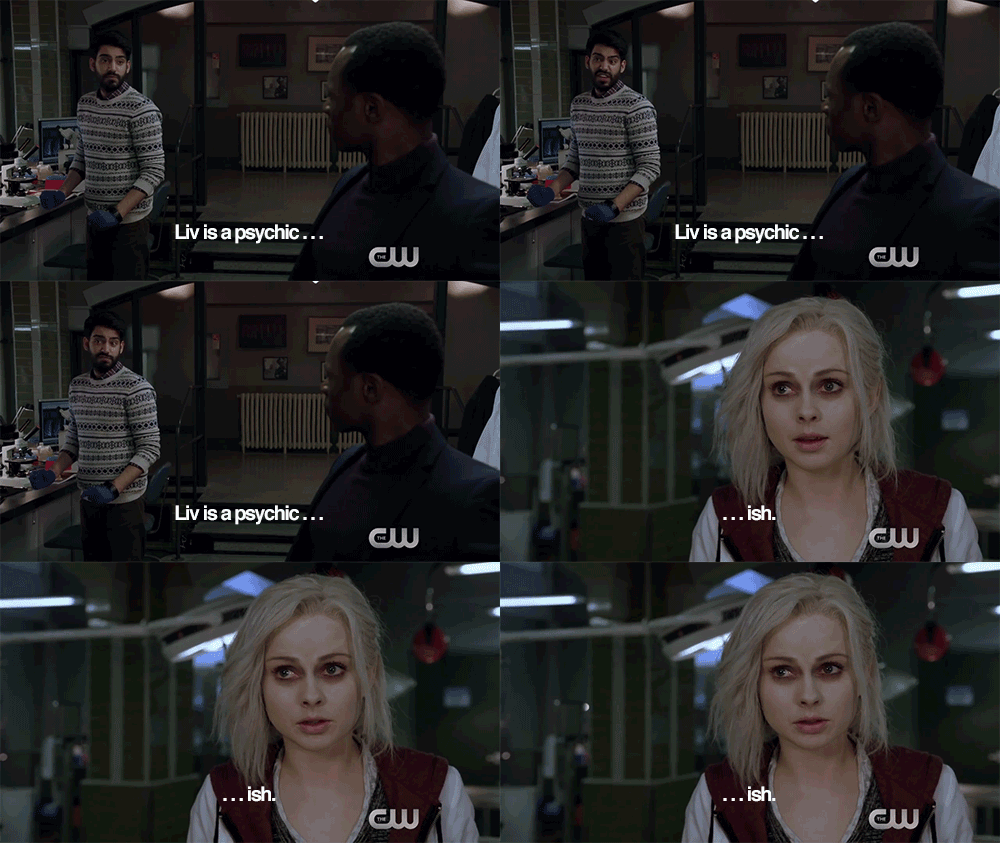
I’m going to talk about two Paranormal Police Procedurals that I watch that are adaptations from comics, iZombie and Lucifer. While I enjoy both of them, I worry about this adaptation trend. This isn’t a bad way to adapt comics but is in some ways lazy. Rather than dealing with the complexity inherent in the stories of the source material TV adaptors just take a known structure and add the comic characters. This isn’t always the case with comic adaptations, such as The Walking Dead, but with two series using this same formula within two television seasons it’s starting to become suspicious.

Beyond that structure, they are interesting shows in their own right but, like Sleepy Hollow, it is their likely paranormal premises that will determine the endurance of their shows. Like Sleepy Hollow, which shares the same network, Lucifer draws from Judeo-Christian roots for their paranormal world. iZombie, the show, draws from Zombie lore, exclusively. This comes in contrast to the comic, which combines zombies, were-beings, ghosts, and vampires into one “undead” group depending on how the two souls of a human leave the body. The show has yet to, and may never, explore this aspect of the comic.

iZombie is my current favorite of the two. iZombie has it’s problems, some of which I touched on in a previous blog, but it’s paranormal premise allows for a very long run of the show. If there are infinite murders, there are infinite possible personalities that Liv can take on and we can have a show that every week is fresh and different as long as the writers continue to write interesting people that get murdered. This pattern can get boring, as there’s no reason to keep watching if it’s always different, but the writers have created 3-4 subplots that allow the series to fit this system without going out of style. Those are:

1) Zombie-ism is related to a drug

2) That drug is big business

3) Zombie-ism is big business

4) There is a big corporation trying to do something with zombie-ism and energy drinks

5) Zombie-ism is virus based so a cure is possible.

While this seems complex and perhaps too many plots for one show, it allows links between episodes that vary depending on the amounts of each subplot and moves both over-arching and within episode plots. Once these are resolved it’s not improbable that the Zombie stories start to reach outside Seattle, for individuals and issues farther afield, but at its present pace it seems unlikely that they’ll resolve all these plotlines soon.

Now onto Lucifer. Lucifer is good, well he’s actually bad, well actually he’s sort of himself and really putting a value on what he is or is not doing really isn’t valuable. Anyways, the show is funny and Lucifer is charming although it occasionally falls back on tropes. These tropes and it’s use of a Judeo-Christian paranormal premise, like Sleepy Hollow, make me question how long the show will hang around. While there are police sub-plots developing in Lucifer, these are not unique to the PPP genre and don’t really utilize what makes PPPs interesting. From that, the biggest problem I foresee with Lucifer is what the actual paranormal sub-plot is and how long can this actually go on for. Lucifer’s only sub-plot, that connects each week, is the will-he-or-won’t-he go back into the Hell business. This is probably related to the sub-plot of why-the-hell-pun-intended-is-officer-Decker-not-subject-to-Lucifer’s-powers but at this point we don’t know. The problem with this is that, even though beings from heaven have as long as they’d like to wax poetic and be will-the-or-won’t-they about God, it can only go on for so long before audiences are bored.

Therefore, if he goes back the show ends or he does some sort of weird and probably not satisfying part-time thing and if he doesn’t go back then we keep playing this game, no reason why God should stop pestering him, and my assumption would be that Lucifer loses his powers. Which may begin a cycle of, “Oh no I’d like those back please” that reignites the previous yes/no on Hell discussion. There are more possibilities than what I’ve outlined but based on the current sub-plots I’m not sure where they’re going. Thankfully, the premise is more open-ended than for Sleepy Hollow and there is the possibility of an infinite yes/no to Hell. Also because most of the murders are not directly tied to the supernatural element it’s likely that it could go on indefinitely and the problem is how long can they keep Lucifer, person and show, entertaining without commitment.

Both have potential to be long running series but the way that they develop their supernatural elements will eventually make or break each one. Shows similar to Lucifer, such as Sleepy Hollow and NBC’s Constantine, have had trouble keeping their Judeo-Christian lore straight and making the world development steady enough to sustain a long-running series. While there isn’t a show similar to iZombie in relation to its supernatural element, it has the potential like other shows that work on the girl with many faces premise, Dollhouse and Orphan Black, to get boring if the character of the protagonist doesn’t solidify. Essentially, while linked by the overarching plots, iZombie may fall into “theme” episodes with changes to the protagonist’s identity masquerading as character development. I hope both continue for a long time, or at least as long as Grimm has, but like all good stories careful planning is what will allow each to tell important meaningful stories rather than fizzle out.

Wednesday, March 23, 2016

PPPs – Part II – The Faltering of Sleepy Hollow

Let me preface this by saying I loved Sleepy Hollow. I really did. The first season blew me away and made me question every other ridiculous show idea I had ever heard of because they really hit it out of the park. Season 2 did not have this same effect and season 3 has me even more disappointed. Some of you who know me may go “Hey wait, you watch Once Upon A Time which is much worse than Sleepy Hollow” and I do not deny this but unfortunately OUAT started out mediocre and continues to be that same low-level Pork Rinds level entertainment. Sleepy Hollow began as a Hannibal Steak and has slowly become McDonalds. But why, why has this happened to one of my favorite TV shows?

In the case of Sleepy Hollow, it begins with the premise for the show and the constraints that their paranormal concept put on the development of a long running PPP series. Brief concept synopsis: A Sleepy Hollow Sheriff, Abigail Mills, meets Ichabod Crane who has woken up 200 years after the American Revolution.

They are the witnesses of God to prevent the coming apocalypse and the headless horseman that Ichabod fought 200 years ago was one of those horsemen one of the harbingers of Moloch who wants to bring the dead into the world of the living and create chaos.

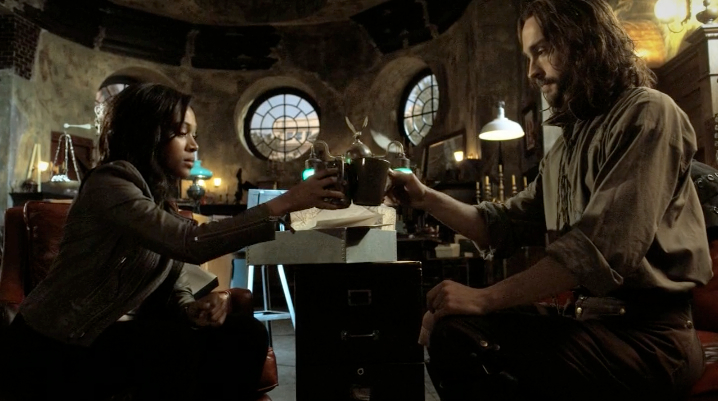
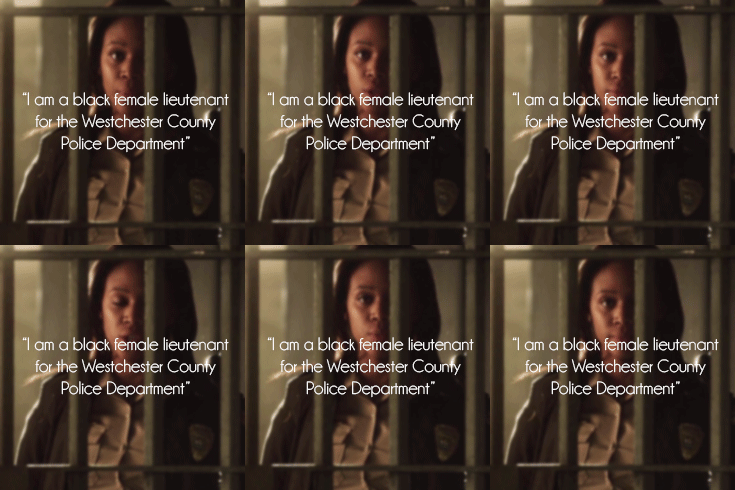
In general, this means that they draw from Judeo-Christian biblical lore and to a certain degree pre-Judeo-Christian monotheism myths. That’s the realm they are working from with a bit of American folklore, the headless horseman and Salem witches, mixed in to rationalized why the hell this would happen in the Northeast of America and not somewhere with exponentially more historical, archaeological, ancient depth. This sounds a bit absurd but also awesome. Two witnesses, one an awesome Black Woman Cop and the other an upper class White Dude actually from the 1700s, have to stop the apocalypse. Also cool: underground revolutionary tunnels, archives, flashbacks to the revolution, and hilarious problems about dealing with modern technology.

Problem: Where do you go from there?

In my mind, the show would have run 4 seasons (or up to 7 depending on how deep you went into the biblical stuff). One year for each of the horsemen, or harbingers, and then ended with some sort of awesome epic thing. You create your world around this struggle and the impending apocalypse and each year raise the stakes as something goes just a bit wrong even as people are working together to stop it from happening and you stay within the realm of Judeo-Christian-American-Folklore.

Problem: That’s not what they did.

Within 1.5 seasons, Moloch and all his horsemen are defeated, and instead of weekly investigations of murders related to these horsemen and the impending apocalypse, the show is devolving slowly in season three into borderline random paranormal villains killing people. There technically is an overarching story and villain but those are shakily related. Additionally, Abby went from a local Sheriff to an FBI Agent making it exponentially harder to explain why the hell Crane is around all the time and can solve all the murders.

Basically, seasons 2-3 expands Sleepy Hollow’s paranormal world outside their American-folklore-centric- Judeo-Christian premise to encompass all myths from all times and all cultures. The villain switches from Moloch to Pandora, a character from Greek mythology and generally unrelated to monotheistic beliefs, and her minions who range from Chinese to Caribbean demons. Essentially, Sleepy Hollow broke their own internal paranormal logic opening the show up for questions such as “Why didn’t Pandora and Moloch team up to defeat the witnesses”. Good Question. Because when the show started Pandora wasn’t an idea in the minds of the showrunners, that’s why.

This sort of borrowing without world-building is what is slowly eroding this show. While it builds on the strong and enduring idea of a police procedural, its paranormal support has hindered the development of the world of the show which, at least in the beginning, seemed to have a great foundation of concepts and ideas.